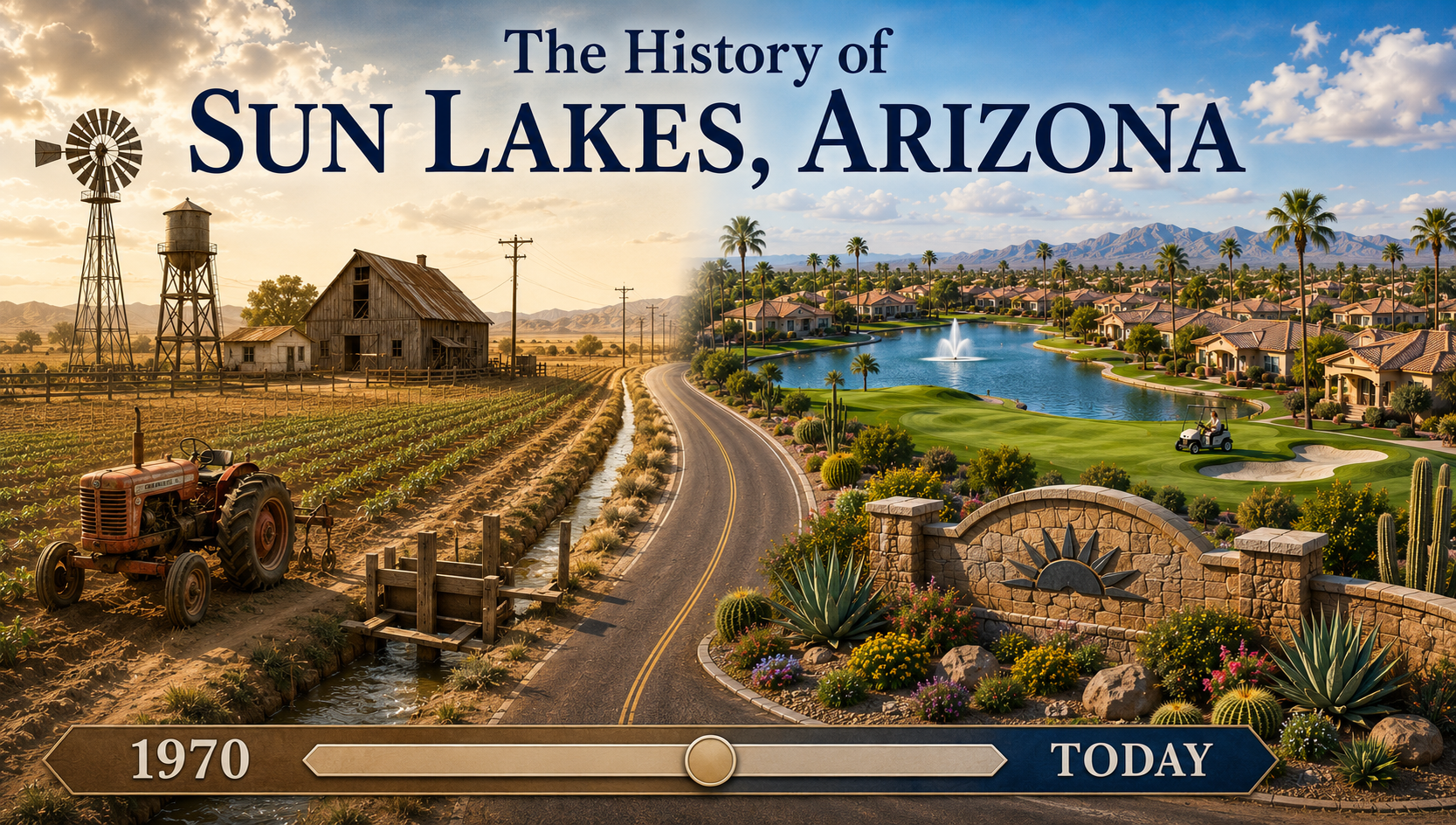
If you had visited Sun Lakes, Arizona, 55 years ago, you would have encountered a vast expanse of active farmland—nearly 2,600 acres, to be exact—just south of Chandler, then a small agricultural town. Today, Sun Lakes is a bustling community with nearly 10,000 homes, and Chandler is a city of 280,000+ people. The development of the Sun Lakes community is credited to Edward J. Robson, a hockey player-turned-real estate agent who saw flat farmland and envisioned a retirement empire decades before “active adult community” was a mainstream concept.
Sun Lakes, Arizona, was Robson’s first active adult community; the success of Sun Lakes directly funded and served as the model Robson repeated at SaddleBrooke, PebbleCreek, and others. Today, Robson Resort Communities houses over 50,000 people across Texas and Arizona.
The Man Behind Sun Lakes, Arizona: Edward J. Robson
After Edward Robson graduated from Colorado College in 1954 (where he played hockey and baseball), he was recruited to play hockey for Team USA, served as an alternate on the U.S. Olympic team in 1956, and became a naval aviator in the U.S. Marine Corps. In 1960, Robson moved to Phoenix and worked as a real estate agent with Coldwell Banker before joining Del Webb Corporation as the Director of Corporate Sales.
When Del Webb opened Sun City in 1960, it was the first age-restricted active adult community of its kind in the country. The opening turned out to be enormous, with over 100,000 visitors over the course of three days; the turnout proved there was a massive, previously untapped demand for retirement communities centered on social life and recreation rather than just housing. Robson saw the development’s success and left Del Webb with two associates to start their own company.
The first development under this new enterprise was River Bend in Bullhead City; the second was a golf community south of Flagstaff called Pinewood. Both of these laid the foundation for when Robson ultimately opened Sun Lakes in 1972.
Buying the Farmland
Where Sun Lakes, Arizona, is today was once acres upon acres of active farmland just south of Chandler, which had a population of 9,531 in 1960, built around acres of cotton, alfalfa, and cattle. Robson and three business partners bought four square miles—2,560 acres—of land in 1972 with the intent to turn it into a living community. The deal was structured as a limited partnership between the four.
Robson had a vision for an affordable community built around an active adult lifestyle in the southeast Valley; Del Webb’s Sun City was in the Northwest Valley and had been wildly successful. The vision turned out to be a good one; not only was there a market for more of these communities, but Chandler itself continued to grow in population, reaching 30,000 residents by 1980 and roughly 290,000 today.
A Rocky Start: Lots, Mobile Homes, and the Energy Crisis
Initially, the Sun Lakes, Arizona venture sold lots and mobile homes instead of built, finished homes. This was a lower-capital way to get the project off the ground and to begin competing with the existing Sun City model. Robson and partners were feeling the pressure from the mid-1970s energy crisis, which was placing financial strain on the project.
The 1973 oil embargo triggered a drastic rise in mortgage rates and inflation across the nation: the average 30-year mortgage rate jumped from 7.38% in 1972 up to 9.19% by 1974. This jump in rates and costs led to a slowdown in home construction and a shift in buyer psychology, with demand easing and credit tightening compared to the high construction and demand levels of the early 1970s.
The team behind Sun Lakes was trying to sell lots and mobile homes in an economy plagued by widespread financial anxiety and high interest rates, which made land and homesite purchases more expensive to finance. The timing was inopportune, and prospects were not promising.
The 1976 Turning Point
After four years as a four-way partnership with his colleagues, Robson bought out his business partners and became the sole owner of the Sun Lakes venture in 1976. Following Robson’s buyout, the company’s model pivoted to focus on single-family home construction, building finished homes rather than selling mobile homes and lots for buyers to build on or manage themselves. Previously, buyers had been responsible for building their own houses or bringing mobile homes onto their purchased lots. Now they could buy a fully finished, move-in-ready home.
Building Out the Five Country Clubs
Sun Lakes focused on broadening its options for different residents, with ranges of exclusivity and tiers to serve a wide range of buyers. The community added new home styles, price points, and paces of life with the addition of new clubs over the years, bringing in a variety of residents and demographics.
Sun Lakes Country Club (1970s)
Sun Lakes Country Club was the first club, consisting of 2,139 homes in a mixture of single-family and manufactured houses and one 18-hole golf course. This was an accessible entry point for buyers, offering a variety of home types built and designed to prove that the active-adult community concept could succeed in the southeast Valley. Sun Lakes Country Club is ungated and served as the foundation from which the rest of the community grew.
Cottonwood Country Club (1980s)
After seeing success with the model, Cottonwood Country Club was added and built on in the 1980s. This ungated club consisted of 2,730 homes across a mix of single-family and villa/duplex homes, giving buyers more home-style choices, plus an 18-hole golf course.
Palo Verde Country Club (1980s–1990s)
The first gated club was added next: Palo Verde Country Club, with 1,073 homes for buyers who preferred more privacy and the feel of a smaller, quieter neighborhood. This club has its own 18-hole golf course and was designed for buyers who didn’t necessarily want the open, spacious feel of other neighborhoods.
Ironwood Country Club (1990s)
The smallest of the five clubs, Ironwood Country Club has only 734 homes and an 18-hole golf course, extending the similar private feeling that Palo Verde introduced. Also gated and more private, Ironwood was designed for buyers who wanted a quieter pace in a community that continued to grow.
Oakwood Country Club (2000s)
The most recent country club addition is also the largest. Oakwood Country Club contains 3,285 homes, a mix of single-family and villa-style houses. There are three 9-hole golf courses, introducing a different format from the other four clubs’ single 18-hole course. With a large home count and distinct golf course layout, this club appeals to buyers who want a newer and more built-out community with a bigger feel.
Robson’s idea to create multiple communities of different sizes and feels allowed Sun Lakes to keep expanding and reaching new levels of success. The result was nearly 10,000 homes sold to retirees with a wide range of retirement preferences.
Flagship of Robson Resort Communities
Sun Lakes, Arizona, was the first of several active adult communities designed by Robson. After Sun Lakes, he went on to develop SaddleBrooke in 1987, PebbleCreek in 1993, Quail Creek in 1999, and then Robson Ranch Developments.
Sun Lakes reached full sellout capacity in the mid-2000’s, proving that the model worked well and leading to other similar developments that replicated the concept. Today, Sun Lakes continues to serve as a model for active adult retirement communities.
To check out available homes in Sun Lakes, Arizona, or learn more information about the community, contact the Kolb Team today.
Frequently Asked Questions About Sun Lakes, Arizona
- Is Sun Lakes related to Del Webb’s Sun City?
No. Sun Lakes and Sun City are separate developments built by different companies. Sun City by Del Webb (opened in 1960) is in the Northwest Valley; Sun Lakes by Robson (founded 1972) is in the Southeast Valley near Chandler. The only connection between the two communities is that Robson worked at Del Webb before starting Sun Lakes; they are not affiliated. - Can you still buy new construction in Sun Lakes?
No. Sun Lakes, Arizona, reached 100% build-out around two decades ago. Oakwood was the last community completed in 2006. (the last community completed) Finishing construction in 2006. All of the homes available today are resales. - What are the age requirements to live in Sun Lakes, Arizona?
The Sun Lakes community is age-restricted, generally requiring at least one resident per household to be 55 or older. People under the age of 19 are not allowed to live in Sun Lakes as permanent residents. The exact rule regarding age requirements can vary slightly by community, so The Kolb Team recommends confirming with the specific HOA for your community of interest. - How many HOAs govern Sun Lakes, and which one would I be in?
Sun Lakes is governed by three separate HOAs rather than one master association: Sun Lakes Country Club has its own HOA, Cottonwood and Palo Verde share an HOA, and Ironwood and Oakwood share one known as IronOaks. The HOA that you would be in depends on which of the five communities your home is in. - How far is Sun Lakes from Phoenix?
Sun Lakes sits roughly 22 miles southeast of downtown Phoenix. The community is just south of Chandler, with easy access to I-10 and the 202 loop to access other parts of the Valley. - How many people live in Sun Lakes, Arizona, today?
The Sun Lakes community had 14,868 residents, up from 13,975 in 2010, according to the 2020 U.S. census data. Nearly 79% of residents are 65 or older.